
Bridal Size Chart
Wedding dress sizes don’t match high-street sizes: many brides find their bridal size is one or two sizes larger than what they usually wear. This calculator uses your bust, waist and hip measurements with a typical bridal size chart, shows which measurement decides your size, and explains why brides are usually advised to order to their largest measurement and alter down.
- Free to use
- No sign-up
- Runs in your browser

Bridal size calculator
Bridal Size and Fitting Pack
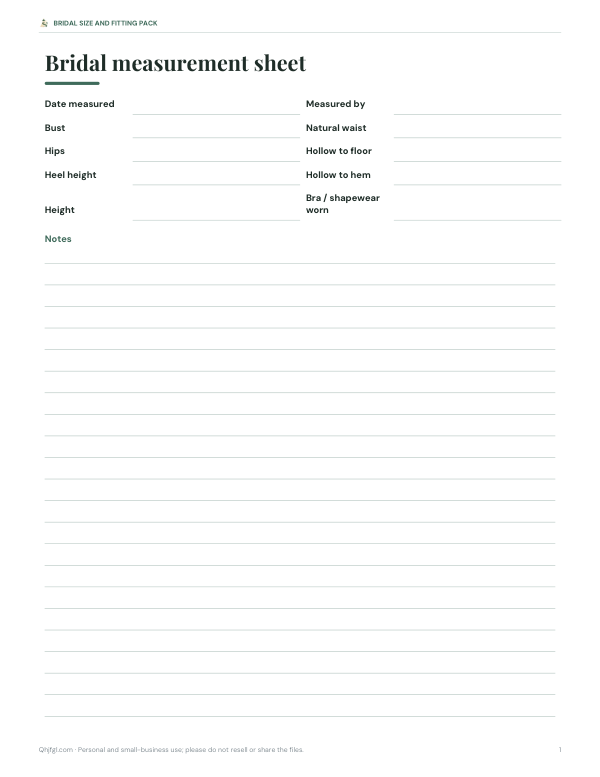
Printable bridal fitting planner: measurement sheet, typical bridal size chart, fittings and alterations tracker and a bridesmaid measurement collection sheet.
- Measurement sheet (PDF/DOCX)
- Size chart (PDF/XLSX)
- Fittings tracker (PDF/DOCX/XLSX)
- Bridesmaid sheet (PDF/DOCX/XLSX)
Formats: PDF, DOCX, XLSX. Instant download after payment (link valid 72 hours, up to 5 downloads). AI-assisted: the templates were drafted with AI help and reviewed and laid out before publishing.
$3.00 USD, one-time 4 files · about $0.75 each
- Instant download
- 7-day refund
- Secure checkout by Stripe
7-day money-back guarantee. Full refund within 7 days of purchase, even after you download.
Free sample: Bridal Measurement Sheet (PDF, 54 KB)
Full refund within 7 days — see the refund policy and license.
Free printables
Single sheets you can print right now, no sign-up. The full pack adds every sheet in one download plus the editable files.
 Printable Bridesmaid Measurement Chart
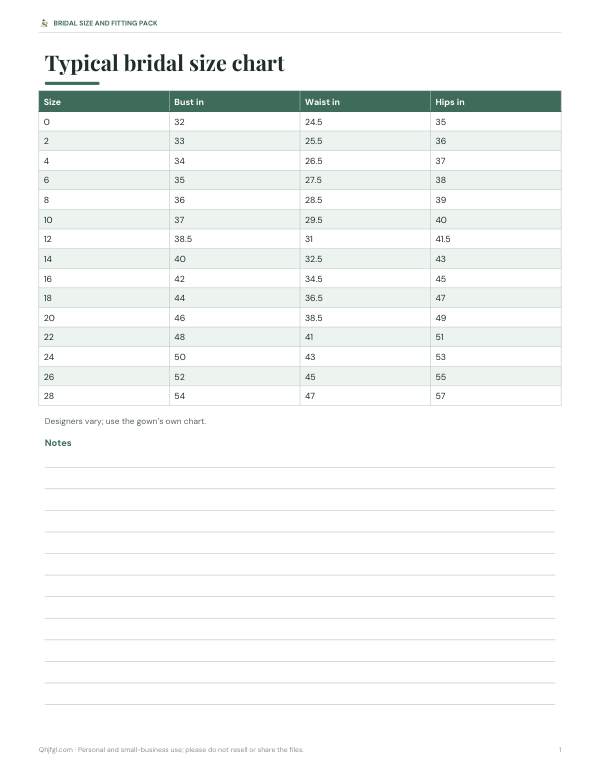
Typical bridal size chart
| Bridal size | Bust (in) | Waist (in) | Hips (in) | Bust (cm) | Waist (cm) | Hips (cm) |
|---|---|---|---|---|---|---|
| 0 | 32 | 24.5 | 35 | 81 | 62 | 89 |
| 2 | 33 | 25.5 | 36 | 84 | 65 | 91 |
| 4 | 34 | 26.5 | 37 | 86 | 67 | 94 |
| 6 | 35 | 27.5 | 38 | 89 | 70 | 97 |
| 8 | 36 | 28.5 | 39 | 91 | 72 | 99 |
| 10 | 37 | 29.5 | 40 | 94 | 75 | 102 |
| 12 | 38.5 | 31 | 41.5 | 98 | 79 | 105 |
| 14 | 40 | 32.5 | 43 | 102 | 83 | 109 |
| 16 | 42 | 34.5 | 45 | 107 | 88 | 114 |
| 18 | 44 | 36.5 | 47 | 112 | 93 | 119 |
| 20 | 46 | 38.5 | 49 | 117 | 98 | 124 |
| 22 | 48 | 41 | 51 | 122 | 104 | 130 |
| 24 | 50 | 43 | 53 | 127 | 109 | 135 |
| 26 | 52 | 45 | 55 | 132 | 114 | 140 |
| 28 | 54 | 47 | 57 | 137 | 119 | 145 |
This is a composite of the kind of chart used by many US bridal designers, not any one brand’s chart. Designers vary by an inch or more, and some use European or UK sizing; the shop will measure you and use the chart for the specific gown.
Why bridal sizes run small
Everyday clothing has drifted larger over the decades — so-called vanity sizing — while many bridal designers still use traditional size charts. A woman who wears a US 8 in shops may measure as a bridal 10 or 12. It is just a number on a label that nobody sees, and the dress will be altered to fit you exactly. Bridal gowns are also usually made in structured fabrics with little or no stretch, so there is no give to hide a size that is too small.
How to measure for a wedding dress
- Wear the underwear and bra (or no bra) you plan to wear on the day — it changes the bust measurement.
- Bust: around the fullest part, tape level across the back.
- Waist: the natural waist, the narrowest part of the torso, usually an inch or so above the navel.
- Hips: the fullest part of the hips and bottom, feet together.
- Hollow to hem: from the hollow at the base of the neck, straight down to the floor, barefoot; then add your heel height.
- Have someone else measure you, and measure twice.
Ordering to your largest measurement
Because a gown must close over every part of your body, the size is decided by your largest measurement relative to the chart. If your bust says 10, your waist 8 and your hips 12, you order a 12 and have the bust and waist taken in. Letting a gown out is often limited by the seam allowance — and some designs, like beaded bodices, can barely be let out at all. Many bridal shops strongly advise against ordering a smaller size in anticipation of weight loss; a gown can be taken in later.
Worked example
A bride measures bust 37, waist 30 and hips 40 inches and usually wears a street size 8. On the chart, a 37-inch bust fits size 10, a 30-inch waist needs size 12 (size 10 is 29.5), and 40-inch hips fit size 10. The waist decides: she orders a 12, whose chart measurements are 38.5 / 31 / 41.5. Her seamstress takes in about 1.5 inches at the bust and hips and 1 inch at the waist. Her hollow-to-floor is 58 inches and she will wear 3-inch heels, so she needs a 61-inch hollow to hem — worth asking the shop about extra length.
Timeline for ordering and alterations
| When | What |
|---|---|
| 9–12 months before | Start shopping; many gowns take 4–6 months or more to make |
| 6–8 months before | Order the dress, with measurements taken by the shop |
| 2–3 months before | First fitting; bring the shoes and underwear |
| 1 month before | Second fitting |
| 1–2 weeks before | Final fitting and pick-up |
Rush orders and off-the-rack gowns shorten this timeline, often for a fee. Alteration costs vary widely — hemming a multi-layer skirt, adding a bustle and taking in a beaded bodice are among the more complex jobs.
Common alterations
- Hemming — often the most common, especially with layered skirts.
- Taking in the bodice or side seams.
- Adding a bustle to lift a train for the reception.
- Adjusting or adding straps.
- Adding cups or bust support.
- Shortening straps to raise the bodice.
Silhouettes and fit
| Silhouette | Measurement that matters most |
|---|---|
| Ball gown | Bust and waist — the skirt is full |
| A-line | Bust and waist |
| Mermaid / trumpet | Bust, waist and hips — fitted to the knee |
| Sheath / column | All three, plus length |
| Empire | Bust and under-bust |
Fitted silhouettes leave the least room for error, so measure carefully and allow extra time for fittings.
Bridesmaid and mother-of-the-bride sizes
Bridesmaid dresses from bridal brands usually follow the same small-running charts as wedding gowns, so bridesmaids should also be measured rather than ordering their street size. Make one person responsible for collecting measurements and double-checking sizes against the chart before ordering.
Frequently asked questions
Do wedding dresses run small?
Often, yes — many brides are one or two sizes larger in bridal sizing than in street sizing.
Should I order a wedding dress by bust, waist or hips?
By your largest measurement relative to the chart, then alter the rest down.
What is hollow to hem?
The length from the hollow at the base of your neck to the hem, measured in the shoes you’ll wear.
How early should I order my wedding dress?
Often 6–8 months before the wedding, sometimes more.
Can a wedding dress be made bigger?
Sometimes a little, depending on seam allowance and construction; taking in is usually easier.
Are my measurements saved?
No. They stay in your browser.